
BPR was introduced to protect trading businesses from Inheritance Tax at the point of succession. When your company qualifies, shares and qualifying business assets can pass to your heirs at up to 100% IHT relief - meaning no Inheritance Tax charge on those assets.
To qualify, a business must be primarily a trading company, not an investment company. HMRC has the power to reclassify a business as an investment company if it holds too much cash or too many non-trading assets relative to its trading activity - and that reclassification can happen without any deliberate action on your part.
The relief has been available since 1976 and remains one of the most powerful estate planning tools in existence - but only where the underlying business structure supports it.
There are two separate mechanisms by which a company can lose BPR, and most directors are unaware of either until it is too late.
The trading company test
HMRC requires your company to be wholly or mainly a trading company. Once investment assets or investment-type activity approaches 20% of the business, HMRC's view of your company begins to change. Cross 50% and BPR is lost entirely. A business can drift from qualifying trading company to investment company status without anyone noticing.
The excepted assets rule
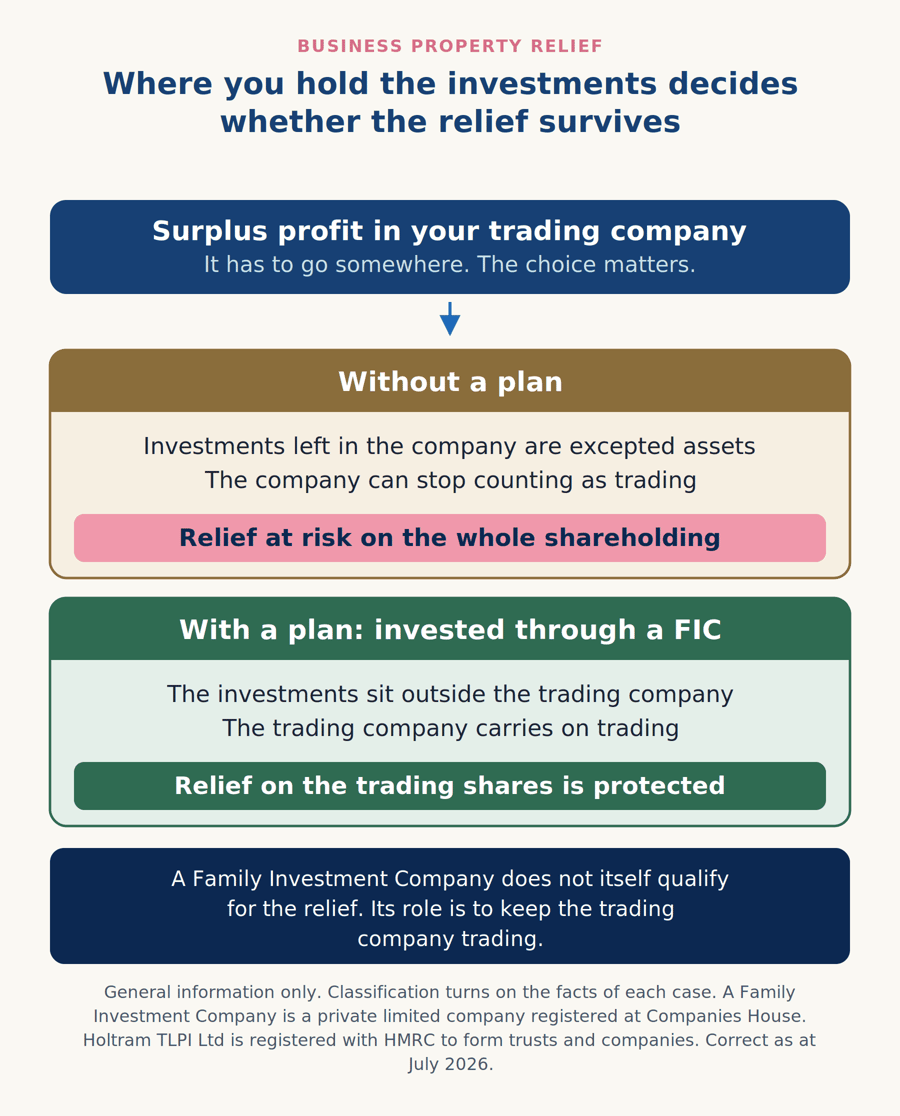
Even where a company passes the overall trading company test, specific assets can be excluded from BPR. HMRC calls these “excepted assets” - and surplus cash is the most common example.
If your company holds retained profits that are not demonstrably needed for the day-to-day operation of the business, HMRC can exclude that cash from BPR relief. This is not a future risk - it applies to your current balance sheet. HMRC will not accept a general “rainy day fund” as a business need. Everything above what the business actively needs to trade is at risk.
From 6 April 2027, unused pension funds - including SSAS pension schemes - will form part of your estate for Inheritance Tax purposes.
Previously, money held within a SSAS could pass to beneficiaries outside the IHT estate. From April 2027, it will not. Business Property Relief does not apply to pension assets, so the rationale that made pension accumulation attractive from an IHT perspective changes fundamentally.
For directors who have been building pension wealth with an IHT objective in mind, the position needs to be reviewed before April 2027. A Family Investment Company - or a combined SSAS and FIC structure - may offer a more appropriate strategy once pension assets enter the taxable estate.
TLPI does not position a SSAS as an Inheritance Tax planning vehicle. Its primary value remains Corporation Tax reduction and pension investment control.
The immediate risk: surplus cash
Most directors focus on the new £2.5 million cap when they hear about BPR changes. But for the company directors TLPI works with, the more immediate concern is one that has always existed and is routinely overlooked: surplus cash sitting in the trading company.
Under HMRC’s excepted assets rules, retained profits not demonstrably needed for day-to-day trading can be excluded from BPR right now. At the point of transfer, HMRC reviews the balance sheet and strips out any cash it considers surplus. That cash then faces the full 40% Inheritance Tax charge.
Many directors hold significant retained profits for entirely sensible reasons. HMRC does not consider these trading requirements. This risk is already affecting directors today - not at some future trigger point.
The April 2026 cap
The diagram below shows what is actually at risk, and how holding investments through a Family Investment Company keeps the trading company trading.
From April 2026, BPR is capped at £2.5 million at 100% relief. Assets above that threshold receive 50% relief, creating an effective 20% Inheritance Tax rate on the excess. This is a secondary concern if surplus cash has already undermined the BPR qualification on those assets.
Both risks - the excepted assets problem and the cap - can be addressed by moving surplus profits out of the trading company into a properly structured vehicle before the point of transfer.
A free, no-obligation call to discuss your options.