
A Family Investment Company (FIC) has become one of the most talked-about structures in UK tax planning, and for good reason. It offers company directors and business owners a way to grow family wealth, reduce exposure to Inheritance Tax and keep full control of their assets, all within a framework HMRC treats as entirely standard. This guide explains what a Family Investment Company is, how it works, who it suits, and how it compares with the alternatives, so you can decide whether it deserves a place in your own planning.
What is a Family Investment Company?
A Family Investment Company is a private limited company set up to hold and grow wealth for the benefit of a family, rather than to trade. It is incorporated at Companies House in the same way as any other UK company, with a memorandum, articles of association and a share register. The difference lies in its purpose and its design: instead of selling goods or services, a FIC holds investments such as cash, share portfolios and property, and its articles and share structure are drafted so that one person, usually the founding director, keeps control while the value of the company builds up for the wider family.
The structure gained popularity as a modern alternative to the family trust. Changes to trust taxation in 2006 made trusts significantly less attractive for holding large sums, and business owners began looking for a vehicle that offered the same separation of wealth from the personal estate without the trust tax regime. A private limited company, governed by ordinary company law and taxed under the ordinary Corporation Tax rules, answered that need.
It is important to be clear about what a FIC is not. It is not a trust, it is not a regulated investment product, and it is not a scheme that depends on any special concession from HMRC. It is a company, and everything it does is visible, familiar and long established in UK law.
How does a Family Investment Company work?
A FIC works in three stages: funding, investing and distributing.
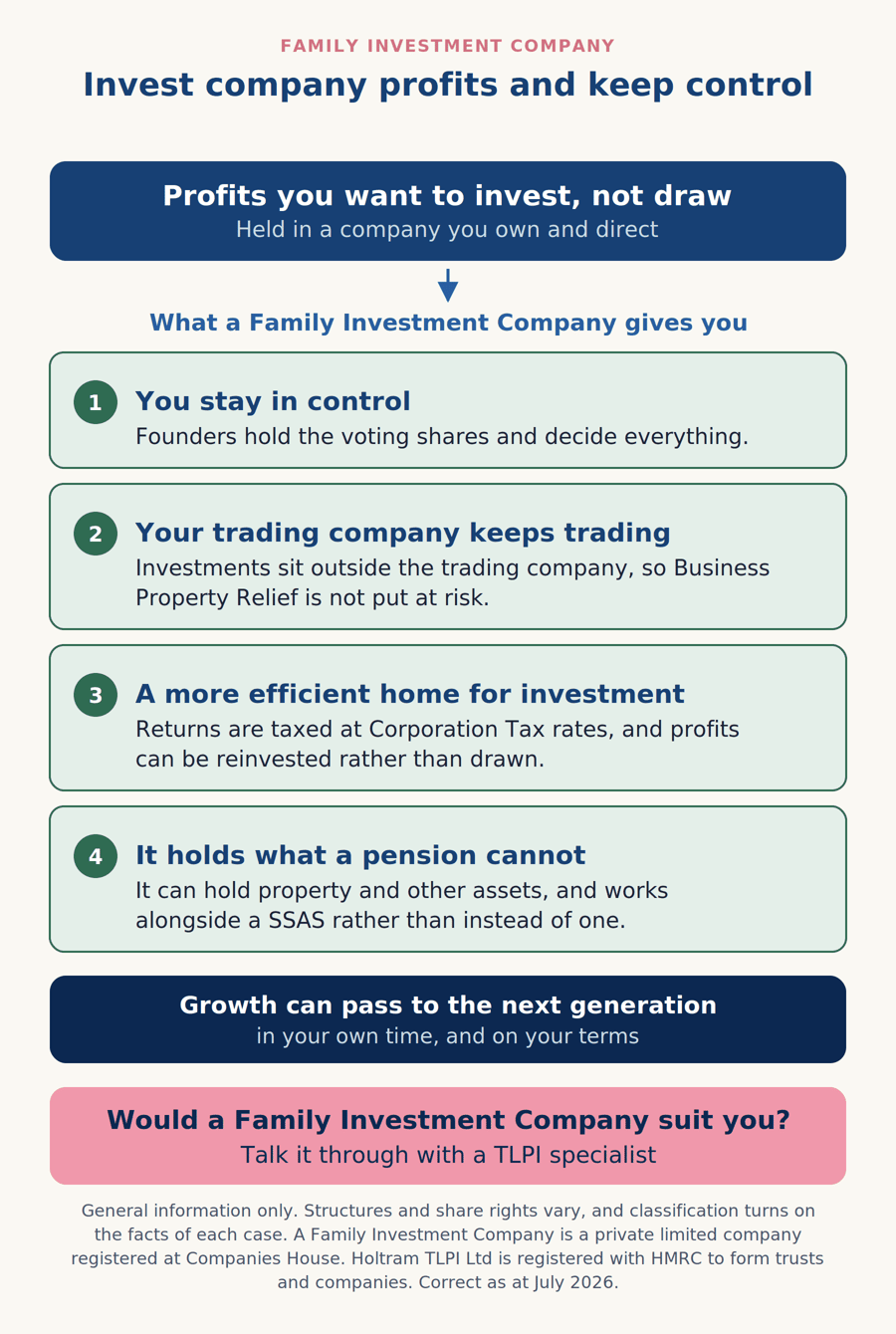
The diagram below sets out what a Family Investment Company gives a director, starting with the part that matters most: you keep control.
Funding usually happens in one of two ways. The founder can subscribe for shares, putting cash into the company in exchange for equity, or lend money to the company, creating a director's loan that the company owes back. Many FICs use a combination: a modest share subscription to establish the share structure, and a larger loan to provide investment capital. The loan route is popular because the company can repay it to the founder over time without any tax charge, since it is simply the return of their own money.
Once funded, the company invests. A FIC can hold cash deposits, listed shares and funds, and investment property, including buy-to-let residential property, which a pension cannot hold. The income and gains those investments produce belong to the company and are taxed under the Corporation Tax regime rather than at personal tax rates.
Distribution is where the share structure earns its keep. Different classes of shares allow dividends to be paid selectively, so income can be directed to family members in lower tax bands when it suits the family to draw money out. Value that stays inside the company continues to compound at Corporation Tax rates. The founder, holding the voting shares, decides if and when any distribution happens.
Who is a Family Investment Company suitable for?
A FIC suits company directors and business owners with surplus cash or retained profits beyond what the business needs as working capital, higher-rate and additional-rate taxpayers holding investments personally, and families who want wealth to pass down over the long term without giving up control.
Whether it fits your own circumstances depends on the size of the surplus, your timescale, and what you already have in place. We work through that in detail on the Family Investment Company page.
What are the tax advantages of a Family Investment Company?
The tax case for a FIC rests on the difference between corporate and personal tax rates.
Income and gains inside the company are subject to Corporation Tax. Held personally, the same returns could face Income Tax, dividend tax or Capital Gains Tax at higher personal rates. On a substantial portfolio, that difference compounds year after year, and the long-term effect on the size of the fund is significant.
Dividends the FIC receives from most listed shares and funds are generally exempt from Corporation Tax altogether, which makes a company an efficient wrapper for an equity portfolio. Investment management costs relating to the portfolio can also attract corporate tax relief, which is not available to a personal investor.
Extraction is flexible. Where the founder funded the company by loan, repayments of that loan come out free of tax. Dividends can be paid on specific share classes, so a family member with little or no other income can receive dividends taxed at their own marginal rate rather than the founder's. Nothing has to be drawn at all: many families deliberately leave the fund rolling up inside the company for a generation.
None of this relies on reliefs that could be withdrawn or on aggressive interpretation. It is the ordinary UK Corporation Tax system, applied to an investment company.
How does a Family Investment Company reduce Inheritance Tax?
Inheritance Tax is charged at 40 per cent on the value of an estate above the available nil-rate bands, and for successful business owners it is often the single largest tax their family will ever face. A FIC addresses it in a structured, gradual way.
The core mechanism is the seven-year rule. When the founder gives shares in the FIC to family members, the gift is a potentially exempt transfer: provided the founder survives seven years from the date of the gift, the value given away falls outside their estate entirely. Because the founder keeps the voting shares, giving away economic value does not mean giving away control.
Growth shares strengthen the effect. If children hold the shares that capture future growth in the company's value from the outset, that growth arises in their hands and never enters the founder's estate at all, so there is no seven-year clock to run on it.
It is equally important to be realistic. A FIC mitigates Inheritance Tax; it does not eliminate it. Value the founder retains, whether in their own shares or in an outstanding loan owed to them by the company, remains part of their estate. The loan can itself be reduced over time, for example by repayment and spending, or by gifting parts of it, but that requires ongoing planning. The FIC is most effective when it is set up early, so the seven-year periods and the growth-share effect have time to work.
What share classes does a Family Investment Company use?
The share structure is the engine of a FIC, and it is tailored to each family through the articles of association. Most structures draw on a small number of building blocks.
Voting shares, often called A shares, carry the right to vote but little or no right to capital or income. The founder holds these, which is what keeps decision-making, including every dividend and every investment choice, in their hands.
Non-voting capital or growth shares, often B or C shares, carry rights to capital growth and dividends but no votes. These are the shares held by, or gifted to, children and other family members, so that value builds up for the next generation without handing over control.
Freezer shares cap the founder's own economic entitlement at the company's current value, so that all future growth accrues to the growth shares held by the family. This is a common way of containing the size of the founder's estate from day one.
Alphabet shares, where several classes have identical rights but dividends can be declared on each class independently, give the directors flexibility to pay different amounts to different shareholders in different years, matching distributions to each person's tax position.
The right combination depends on the family's aims, and it needs to be settled before incorporation, since the structure is difficult to change once value has built up. This is one of the areas where specialist drafting matters most.
Is a Family Investment Company a tax avoidance scheme?
No. This question deserves a direct answer, because it is one of the first things cautious directors ask.
A Family Investment Company is a standard private limited company, formed under the Companies Act and taxed under the same Corporation Tax rules as every other UK company. It does not depend on artificial steps, contrived transactions or any interpretation of the rules that HMRC has challenged. There is nothing to disclose under the tax avoidance disclosure regimes, because there is no scheme: there is a company, holding investments, paying Corporation Tax.
HMRC has looked at FICs closely and said so publicly. In 2019 it formed a dedicated unit within its Wealthy and Mid-sized Business Compliance directorate to examine the use of Family Investment Companies. The unit completed its review in 2021 and was wound up, with HMRC confirming that it had found no evidence of a link between FICs and non-compliant behaviour. FICs are now treated as business as usual within HMRC's normal compliance work.
That review is worth pausing on. The structure was examined by the tax authority for two years, specifically to establish whether it was being used to avoid tax, and the conclusion was that it was not. Few planning structures have been through that process and emerged with their standing confirmed. Families using a FIC are engaging in legitimate, long-established tax planning, using the same company law framework that underpins every business in the country.
What is the difference between a Family Investment Company and a family trust?
A FIC is a private limited company. Its profits are taxed under the Corporation Tax rules, there is no tax charge when money goes in, there are no ten-year anniversary or exit charges, and the founder keeps control through the voting shares. Because a FIC holds investments rather than trades, it cannot use the small profits rate or Marginal Relief, so it pays the main rate of Corporation Tax on all of its profits.
A discretionary trust sits in a different regime altogether. An entry charge applies to amounts settled above the nil-rate band, a further charge falls on every ten-year anniversary and again when capital leaves the trust, income is taxed at the trust rates rather than at company rates, and control rests with the trustees rather than with the settlor.
Neither structure is universally better. Trusts still have a role, particularly for smaller sums within the nil-rate band and for protecting vulnerable beneficiaries. For the full side-by-side comparison, see Family Investment Company versus family trust.
How does a Family Investment Company work alongside a SSAS pension?
For company directors, the FIC rarely stands alone. Its natural partner is the Small Self-Administered Scheme (SSAS), a company pension scheme designed for business owners, and together they address the two biggest tax problems a successful director faces.
The SSAS deals with the Corporation Tax problem. Employer contributions from the trading company into the SSAS attract Corporation Tax relief, reducing the company's tax bill, and the funds then grow inside the pension free of tax on income and gains. The SSAS also gives the director unusual control over how those funds are invested: it can purchase commercial property, and it can lend up to 50% of its value back to the sponsoring company as a secured loan for business purposes.
The FIC deals with the succession and Inheritance Tax problem. It holds the surplus wealth that sits outside the pension, cash extracted from the trading company, investment portfolios and property, and passes the growth in that wealth to the next generation whilst the founder keeps control.
One point of honesty matters here. Unspent pension funds are due to be brought within the Inheritance Tax estate from April 2027, so a pension should no longer be relied upon as a way of sheltering wealth from Inheritance Tax. That change makes the division of labour clearer, not weaker: the SSAS is the Corporation Tax and retirement-control vehicle, and the FIC is the succession vehicle. Used together, they form the basis of the Lifetime Business Tax Plan, TLPI's integrated approach to director tax planning.
What does it cost to set up a Family Investment Company?
Setting up a Family Investment Company is specialist work. The articles of association and share structure must be drafted correctly from the outset, the funding route needs to be planned, and the company must be administered properly each year. Getting any of these wrong is difficult to unwind once value has built up, which is why it is important to work with experts such as TLPI rather than attempt it alone.
Costs vary with each family's circumstances, so there is no single figure. As a general rule, a family needs enough investable funds to make the FIC viable, and whether that is the case for you can be discussed on a case by case basis with a TLPI specialist.
How does a Family Investment Company interact with HMRC?
From HMRC's point of view, a Family Investment Company is simply a company. It registers for Corporation Tax after incorporation, files a Corporation Tax return each year, pays tax on its profits at the ordinary rates and files annual accounts at Companies House. Shareholders who receive dividends report them through their own tax returns in the usual way. There is no special registration, clearance or disclosure regime for FICs, because there is nothing non-standard to disclose.
The compliance obligations are the familiar ones of company life: accurate accounts, a confirmation statement, a register of persons with significant control, and proper records of dividends and loans. Any director who has run a trading company will recognise all of it.
One structural point does need care. A FIC is, deliberately, a wholly or mainly investment company, and investment companies do not qualify for Business Property Relief (BPR), the relief that can take trading business assets outside the Inheritance Tax net. That is expected and priced into the planning: the FIC pursues the seven-year gift route instead. The point to watch is contamination in the other direction. If substantial investment assets are allowed to build up inside a trading company, that company risks failing the wholly or mainly trading test and losing its own BPR. Moving surplus investments out of the trading company and into a FIC, done correctly, actually protects the trading company's relief while giving the investments a better home.
Is a Family Investment Company right for me?
That depends on your profit position, how much surplus you hold, whether you are likely to need the capital personally in the near term, and what you already have in a pension. A FIC is rarely the first step, and it is frequently used alongside a SSAS rather than instead of one.
We have set out the full picture, including the situations where a FIC is premature, on the Family Investment Company page. TLPI is a tax planning and pension specialist. Holtram TLPI Ltd is registered with HMRC to form trusts, companies and to administer pensions, so we will set out the structures and the trade-offs rather than advise you on personal financial products.
A free, no-obligation call to discuss your options.