What is a SSAS pension?
A SSAS is an occupational pension scheme which is usually set up by company directors. Members are jointly appointed as trustees of the SSAS scheme, giving them direct control over investment decisions. A SSAS is registered with The Pensions Regulator and HMRC.
Key features of a SSAS
- It is an occupational pension scheme
- Members are usually directors or senior employees of the sponsoring company
- There is a limit of 11 members
- Members are joint trustees with direct control over investments
- The loanback facility allows the pension to lend up to 50% of its value to the sponsoring company
- A SSAS can invest in commercial property, with the option to lease it back to the sponsoring company
- A SSAS is regulated by The Pensions Regulator and HMRC
What is a SIPP?
A SIPP (Self-Invested Personal Pension) is a personal pension plan. Unlike a SSAS, a SIPP is not tied to a company — anyone can take out a SIPP as long as they meet the eligibility criteria. SIPPs provide access to a wide range of investments.
Additional features of a SIPP
- A SIPP is a personal pension plan, not restricted to company employees
- SIPPs typically offer a wider range of investment choices through the open market
- Investment decisions are typically managed through a third-party platform or provider
- Flexibility in drawing benefits at retirement
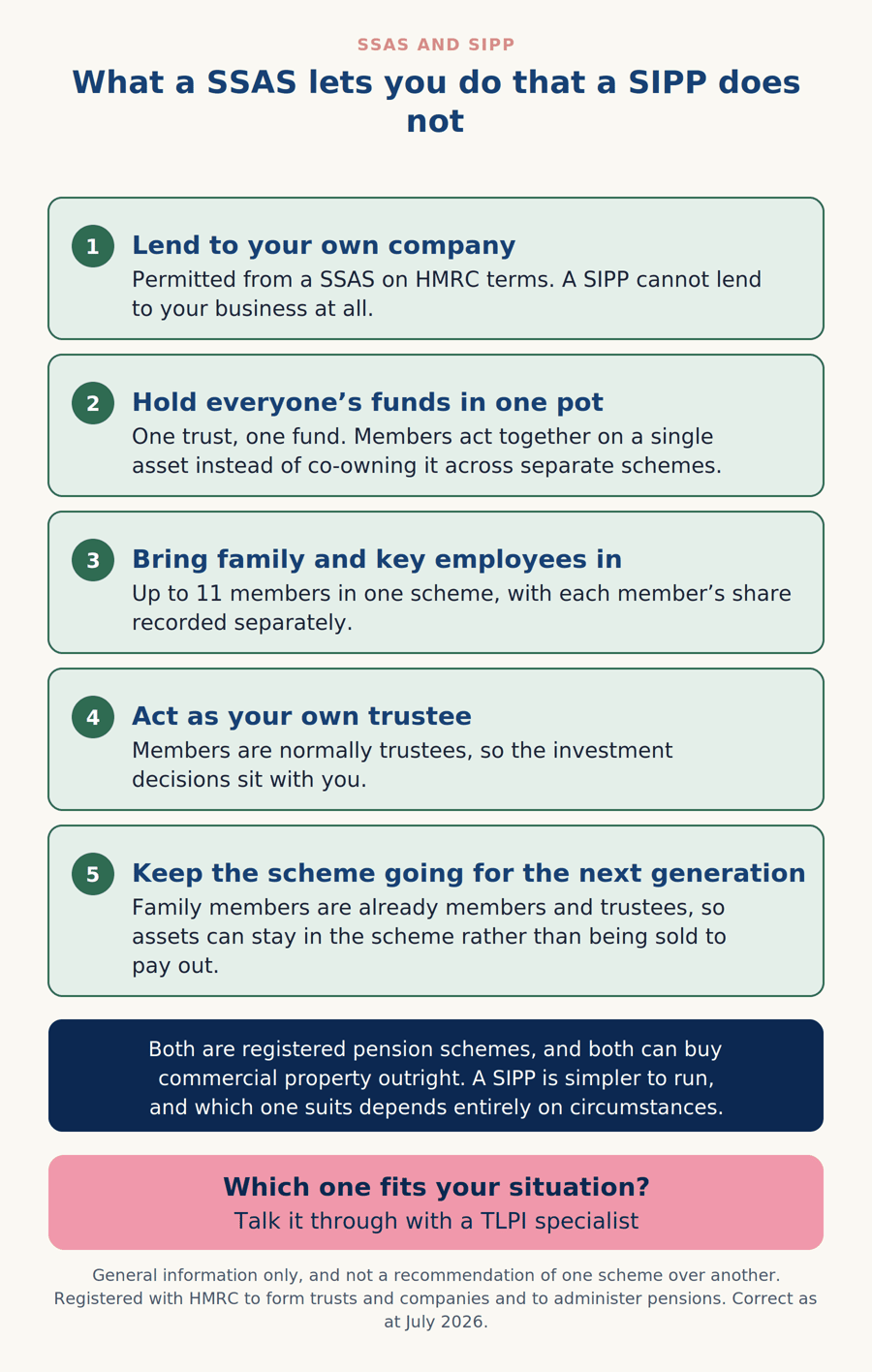
The summary below sets out the capabilities a SSAS adds. Which scheme suits depends on circumstances.
SSAS vs SIPP: which is right for you?
Both schemes share several similarities: both are self-invested, both can hold commercial property, and both offer flexibility in drawing benefits. The right choice depends on your circumstances, your company structure, and the size of your pension fund.
A SSAS may suit you if...
- Your individual or combined pension fund exceeds £100,000
- You want to pool your pension fund alongside your spouse, family members or business partner
- You would like the option to lend money from your pension back to your company (loanback)
- You want to manage your pension fund with a more entrepreneurial approach
- You would like to purchase commercial property through your pension
- You want more flexibility and control when dealing with pension investments
- You would like flexibility in drawing benefits at retirement
A SIPP may suit you if...
- Investment decisions are typically managed through a third-party platform or provider
- You want exposure to a broader range of investment markets
- You want flexibility in drawing benefits at retirement
SSAS vs SIPP at a glance
| SSAS | SIPP | |
|---|---|---|
| Who can have one | Available to company directors | Open to anyone |
| Lending to your company | Can lend to the company | Cannot lend to the company |
| Investment options | Greater investment flexibility and control | More restrictive investment options |
| Who acts as trustee | Members are usually trustees | The SIPP provider is trustee |
What each scheme can invest in
A SSAS has more flexibility and choice than a SIPP. When it comes to investment, some of the differences between a SIPP and a SSAS are listed below.
A SSAS
- Can lend up to 50% of the pension fund to sponsoring employers
- Commercial property and land
- All of the investments allowed in a SIPP, listed below
A SIPP
- Unit trusts
- Open Ended Investment Companies (OEICs)
- Exchange Traded Funds (ETFs)
- Gilts
- Commercial property and land, depending on the provider
Who acts as trustee
The trustees and scheme administrators of a SIPP are usually the SIPP provider alone. With a SSAS, the member is usually a trustee. TLPI only deal with SSAS providers who also act as Professional Corporate Trustees, as this gives the member both the control required as a trustee and the guidance of a professional.
The duties of a trustee or scheme administrator include
- Registering with The Pensions Regulator and providing a regular scheme return, unless it is a single person scheme
- Registering the pension scheme with HMRC
- Operating tax relief on contributions under the relief at source system
- Reporting events relating to the scheme and the scheme administrator to HMRC
- Making returns of information to HMRC
- Providing information to scheme members, and others, regarding benefits and transfers
- Paying certain tax charges
- A SSAS is exclusively for company directors and senior employees; a SIPP is open to anyone
- A SSAS allows the pension to lend up to 50% of its value back to the sponsoring company; a SIPP does not
- Both can invest in commercial property, but a SSAS can also lease it back to the sponsoring company
- A SSAS has a maximum of 11 members who act as joint trustees; a SIPP is a single-member personal pension
- A SSAS is generally most cost-effective with a fund above £100,000
A free, no-obligation call to discuss whether a SSAS or SIPP is right for you.