G5 Trusted by 1k+ Business Directors

How to set up a SSAS pension

The easiest way to set up a Small Self-Administered Scheme (SSAS) is to have expert support. TLPI offer a lifetime SSAS service, including setup, pension transfers and ongoing investment support. Every Small Self Administered Scheme (SSAS) needs to be registered with HMRC, however, the process can take some time. It is best to start this as early as possible, especially if you are approaching the end of the financial year.

Speak to a SSAS Expert

No obligationGet personalised guidance.

Getting Started with a SSAS

  • Decide who will be a part of the scheme.
  • You can have up to 11 members. All members must be 18 or older.
  • You can invite directors of the company, other employees, family members, and employees' family members.

7 steps to establish your SSAS

Step 1: Information about Your Company and the Members of the SSAS

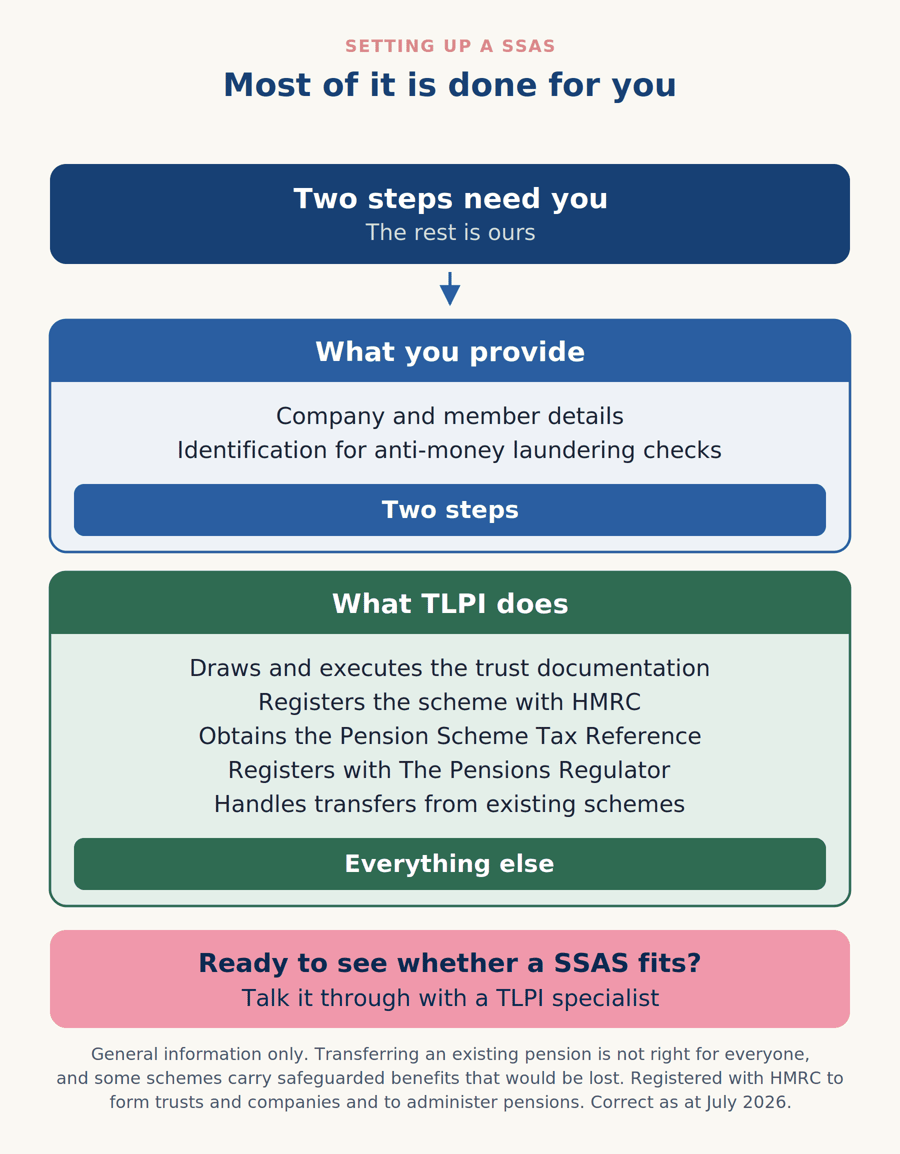
To set up a SSAS, you will need to gather information about your company and each member of the SSAS. Each member will need to provide you with their personal details (contact information, etc.) and a signature. You will also need to decide on a name for your scheme.

In addition to collecting basic details, you will need to know if any members of the pension hold a certificate of protection or a HMRC protection reference number, as well as check if the Money Purchase Annual Allowance applies to any members of your scheme.

Book an enquiry with one of our pension advisers for a full list of the documentation you will need to open a SSAS.

Step 2: Anti-Money Laundering

Complying with anti-money laundering legislation is a legal requirement. It is important that each member of the SSAS has their identity verified.

Step 3: Transfer Existing Pensions

Every member of the SSAS must decide whether they would like to transfer any existing pensions to the new scheme. This is optional and each member may transfer as many or as few pensions as they like. We recommend that each member of a new SSAS talks to an independent financial advisor before making a decision.

Step 4: Trust Documentation

A SSAS is a trust, which means that it is run by designated trustees. All members of the SSAS are trustees, although a member can opt out in very specific circumstances. The SSAS needs at least 1 trustee to continue.

The pension must also include a pension administrator. The SSAS scheme administrator can be a member or trustee or an appointed professional. Being a trustee comes with legal responsibilities, so all trustees should know their obligations and the potential consequences of failing to meet those obligations.

We also recommend that any SSAS service you employ includes legal compliance of the package. This can help protect the scheme from breaching HMRC rules and The Pension Regulator’s regulations.

Step 5: Registering with HMRC

The trust needs to be registered with HMRC before any contributions are received. The trust will also need to open a bank account to receive contributions.

Step 6: Obtain a Pension Scheme Tax Reference Number

A Pension Scheme Tax Reference (PSTR) number is a unique code made up of eight numbers, followed by two letters (XXXX XXXX OO). Every new SSAS will need a PSTR from HMRC, as it shows that the scheme has been registered for tax relief and exemptions.

Step 7: Register the SSAS with the Pensions Regulator

The Pensions Regulator is the UK Regulator for work-based pensions, which includes SSAS. It is important to register your SSAS with the Pensions Regulator. The Pensions Regulator is sponsored by the Department of Work and Pensions (DWP).

m
Straightforward SSAS Establishment

TLPI has a simple process to make establishing a SSAS pension very straightforward. Once the above steps are complete, your SSAS can begin to receive contributions. If you have any questions about any of the steps listed here and would like to speak to a pensions advisor, please call 01235 426666 or book a no obligation consultation online.

Book a no-obligation consultation Learn more about SSAS pensions

No obligationGet personalised guidance.

FAQs

What does SSAS stand for?

SSAS stands for Small Self-Administered Scheme. This is a corporate pension scheme that is managed by trustees of the scheme. It can be set up by company directors. Members of the SSAS can choose how their pension funds are invested. It gives all members of the SSAS scheme more control over their pensions.

What is a SSAS?

A SSAS is a pension trust that gives its members control of their pension funds and assets. A SSAS allows members to invest funds at their own discretion.

A SSAS has access to every type of investment that is allowed under rules set out by legislation, as with traditional pensions. In addition, a SSAS has additional investment privileges, such as investing in property or investing in your business, amongst other things. You can make permitted investments at any age; you do not need to be 55 to take control of the money in your pension.

Click here to download a beginner’s guide

Who is a SSAS for/who can have a SSAS?

A Small Self-Administered Scheme (SSAS) is a pension exclusively for business owners/company directors. The company director sets up the SSAS and is then able to invite up to 10 other members to be part of the scheme. Members can be other company employees or family members.

Can I pay SSAS costs and fees from the SSAS scheme?

Yes. Fees and costs can be paid by the SSAS or by the company.

What are the tax benefits of a SSAS?

  • As a SSAS is registered with HMRC as a UK registered pension scheme, it becomes an extremely tax-efficient wrapper.
  • Sponsoring Employers are able to make contributions and receive upfront tax relief, saving corporation tax.
  • Assets held within the SSAS are free of Corporation Tax, Income Tax, Capital Gains Tax, and has decreased Inheritance Tax liabilities.
  • Personal and company assets can be transferred into the SSAS as contributions.
  • Commercial property held by the SSAS, for example, the company business premises, can grow tax-free within the SSAS whilst earning tax-free gains (rent) from the company, as it does so. Rent is not lost to a landlord.
  • When using the loanback facility, loan payments go back into the SSAS, as opposed to paying the bank. This then grows tax-free within the SSAS.
  • Additional family members can be added to the SSAS to create a tax-efficient family trust.
  • Family assets can be held within the SSAS are ring-fenced from creditors.

Are there any drawbacks to a SSAS pension?

There are no drawbacks to a SSAS pension. A SSAS gets all the same benefits as any other UK pension scheme, such as tax breaks, lifetime limits, drawdown age and 25% tax free cash at age 55, along with the new flexi-drawdown rules. A SSAS is the ultimate director’s, property and business pension.

Most people take little interest in their pensions but when they realise all of the benefits of a SSAS and how the money locked in a pension can be used by SME directors, small businesses and families, the SSAS pension suddenly becomes a very attractive tool to have as a part of your business plans.

How long does it take to set up a SSAS?

Timescales can vary, depending upon relevant checks and paperwork required. Requesting your pension transfer values and setting the transfers in motion quickly will help. It can take a number of weeks to register your SSAS with HMRC and ensure everything is up and running correctly.

Can I set up a SSAS as a family scheme?

A SSAS is an ideal tool for family businesses and as a family trust. HMRC rules allow family members  to be invited to be members of the trust. Having a family SSAS is extremely useful for inheritance planning. With a family SSAS, tax efficiency can be optimised. As pensions are pooled, a family SSAS has great flexibility with regard to taking benefits at retirement and asset transfers. Assets can be held within the SSAS and taken as benefits or left in the SSAS as part of the legacy, as cash benefits are taken when a family member retires. For family businesses, the SSAS allows greater business continuity as family members retire or join the business.

What is the difference between a SSAS and a SIPP?

  • A SSAS is a corporate pension and can have up to 11 members
  • A SIPP is a personal pension and only for individuals
  • A SSAS is exclusively available to company directors
  • SSAS costs are charged per scheme rather than per member
  • A SSAS is its own individual trust and can make its own investment choices
  • A SIPP is regulated by the FCA and HMRC
  • A SSAS is regulated by HMRC and The Pensions Regulator (TPR)
  • A SSAS can loan 50% of its funds to the business
  • A SSAS can invest in commercial property
  • A SSAS can invest in hands-free residential property 

Read more…

What can you use a SSAS for?

  • A SSAS is allowed to invest in everything that traditional pensions can invest in and is afforded the same tax advantages as other pensions.
  • A SSAS can be used to achieve optimum tax efficiency
  • A SSAS can loan 50% of its funds to your company for whatever business purposes you see fit
  • A SSAS can loan to an unconnected 3rd party
  • A SSAS can invest in commercial property
  • A SSAS can invest in hands-free residential property 
  • A SSAS can ring-fence family assets with ultimate tax efficiency
  • A SSAS can invest in hands-free property investments.

Why should I have a SSAS?

  • A SSAS gives you more control and more flexibility
  • A SSAS allows you to pool your pension funds, as well as those of other members
  • A SSAS is extremely tax-efficient
  • A SSAS allows you to invest pension funds into your business
  • A SSAS allows you to invest pension funds at your own discretion

Click to download a beginner’s guide

Is the SSAS a new type of pension?

No. The SSAS has been around since 1973. It was created exclusively for company directors as a corporate pension that is fully compliant with HMRC and The Pension Regulator rules and regulations.

View all