
What tax applies when a family business passes to the next generation?
From 6 April 2026, Agricultural Property Relief and Business Property Relief give 100 per cent relief only on the first £2.5 million of qualifying assets, combined across both reliefs. Above that, relief drops to 50 per cent, giving an effective Inheritance Tax rate of 20 per cent on the excess. Any unused allowance is transferable between spouses and civil partners.
Tax legislation has tightened the position for family businesses. Agricultural Property Relief and Business Property Relief, both long-standing tools for reducing the Inheritance Tax burden on business and farming assets, are now capped rather than unlimited. Beyond the allowance, businesses face an immediate liability that previously did not arise. Capital Gains Tax rates have also risen, which makes transferring assets during the owner's lifetime more expensive than it once was. Together these make the timing and structure of a succession plan matter far more than they used to.
Whilst the specifics of these changes impact situations differently, for example APR and farms, they are representative of broader challenges facing family businesses across diverse industries. Without strategic planning, these tax liabilities could result in the forced sale of critical assets, thus disrupting operations and long-term goals.
There is a second change to plan around. From 6 April 2027, most unused pension funds fall within the estate for Inheritance Tax, where previously they sat outside it. For a business owner that means two parts of the same estate tighten within twelve months of each other. The business loses full relief above the £2.5 million allowance, and the pension loses an exemption it has held for a decade. Business Property Relief does not apply to pension assets, so there is no equivalent allowance on that side, and TLPI does not position a SSAS as an Inheritance Tax planning vehicle. You can read more on the April 2027 pension Inheritance Tax changes.
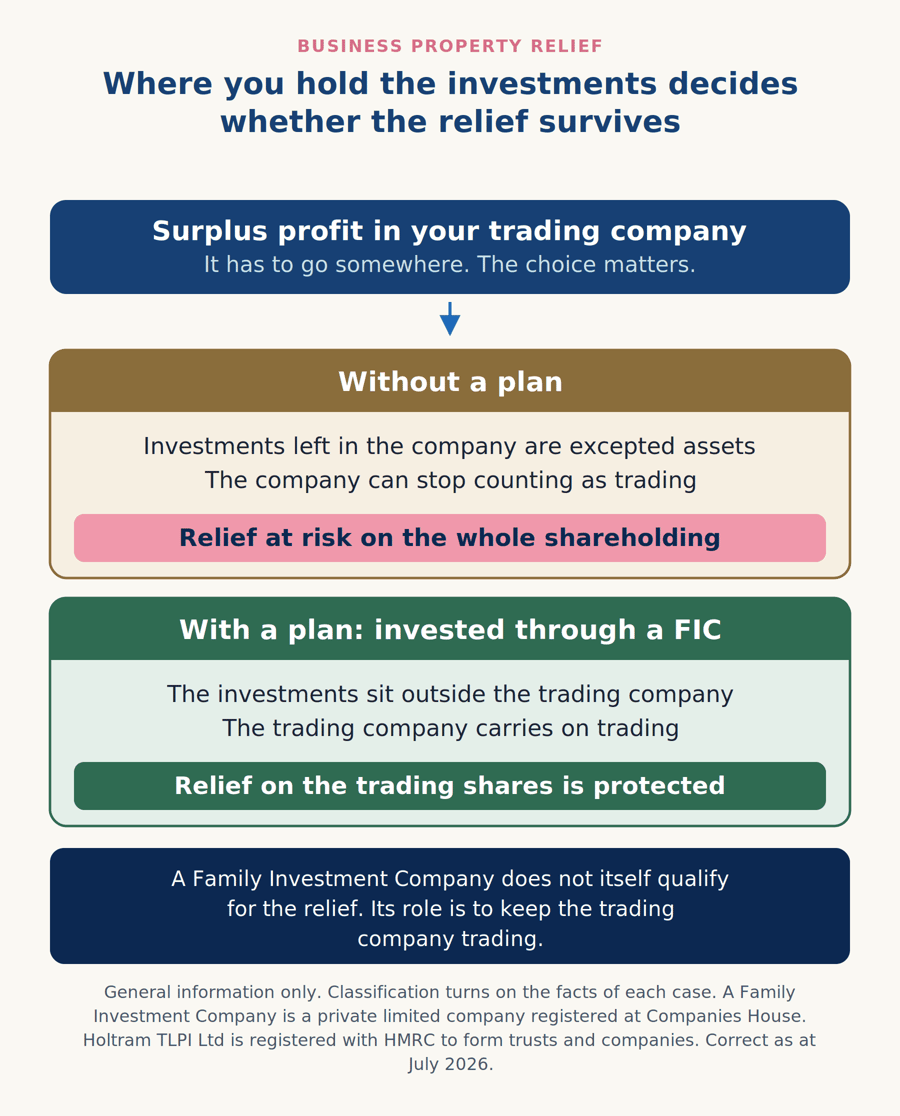
The diagram below shows why where the investments sit decides whether the relief survives.
What is a Family Investment Company and how does it help succession?
A Family Investment Company is a private limited company set up to hold and grow family wealth. The founder keeps control through the share structure while the next generation holds shares carrying future value, so a business can pass down gradually rather than all at once.
A Family Investment Company (FIC) is a private company established to manage and protect family wealth, and is especially designed to facilitate generational transfer of a business and legacy, whilst minimising tax exposure. The usual setup is that the business owner, as the older generation involved, will set up a FIC and retain full control over all decisions. In essence, they will manage this company as they do their trading company. They are able to invest via the FIC, inside of the tax-protected wrapper, without risking the loss of Business Property Relief for the trading company and mitigating IHT as doing so via the FIC. Family members are part of the FIC setup, leveraging IHT exemptions and benefits upon death of the donor. Because assets are held within the FIC, this allows for retirement and succession planning.
Unlike traditional trusts, Family Investment Companies (FICs) offer a greater level of control, more flexibility, and better cost efficiency, which makes them an increasingly popular option for modern and innovative family businesses.
How can a SSAS pension fund business growth?
A SSAS can lend up to 50 per cent of its net asset value back to the sponsoring employer for any valid business purpose, within HMRC conditions. That gives a family business a funding route that also reduces Corporation Tax, without going to an external lender.
For those growing a family business and diversifying to meet the needs of today’s economy, this diversification can be facilitated by the use of pension funds for business growth. By also implementing a Small Self-Administered Scheme (SSAS) pension, 50% of the pension funds can be loaned to the trading company for any valid business purpose. Regulations state that you can set your own, low interest rate on loan repayments (the minimum is 1 per cent above the average base lending rate of six leading high street banks, rounded up to the nearest 0.25 per cent) to achieve low-cost funding or alternatively, set a high interest rate to save Corporation Tax for the trading company and escalate pension growth. This facilitates a rinse-and-repeat strategy meaning you can continue to fund business growth at the same time as growing the legacy.
With the addition of a Small Self-Administered Scheme (SSAS) into your plan, (creating a Lifetime Business Tax Plan), pension funds can be used to loan to the business, providing cash flow, with the interest the company pays on the loan deductible against Corporation Tax. The loan must be paid back to the pension over 5 years, and the loan's interest is classed as a valid business expense. Income that the SSAS receives is not liable for income tax as inside a pension. The business owner must set the repayment rate at or above that minimum, but many set the interest rate high (for example 12%) as this repays the loan quickly, grows the pension to a greater extent, reduces the trading company balance sheet and provides an either larger pot to rinse and repeat the strategy. There are many strategies available to business owners, but each situation is different, so leverage expertise to find out what would work for your business, family, aims and goals.
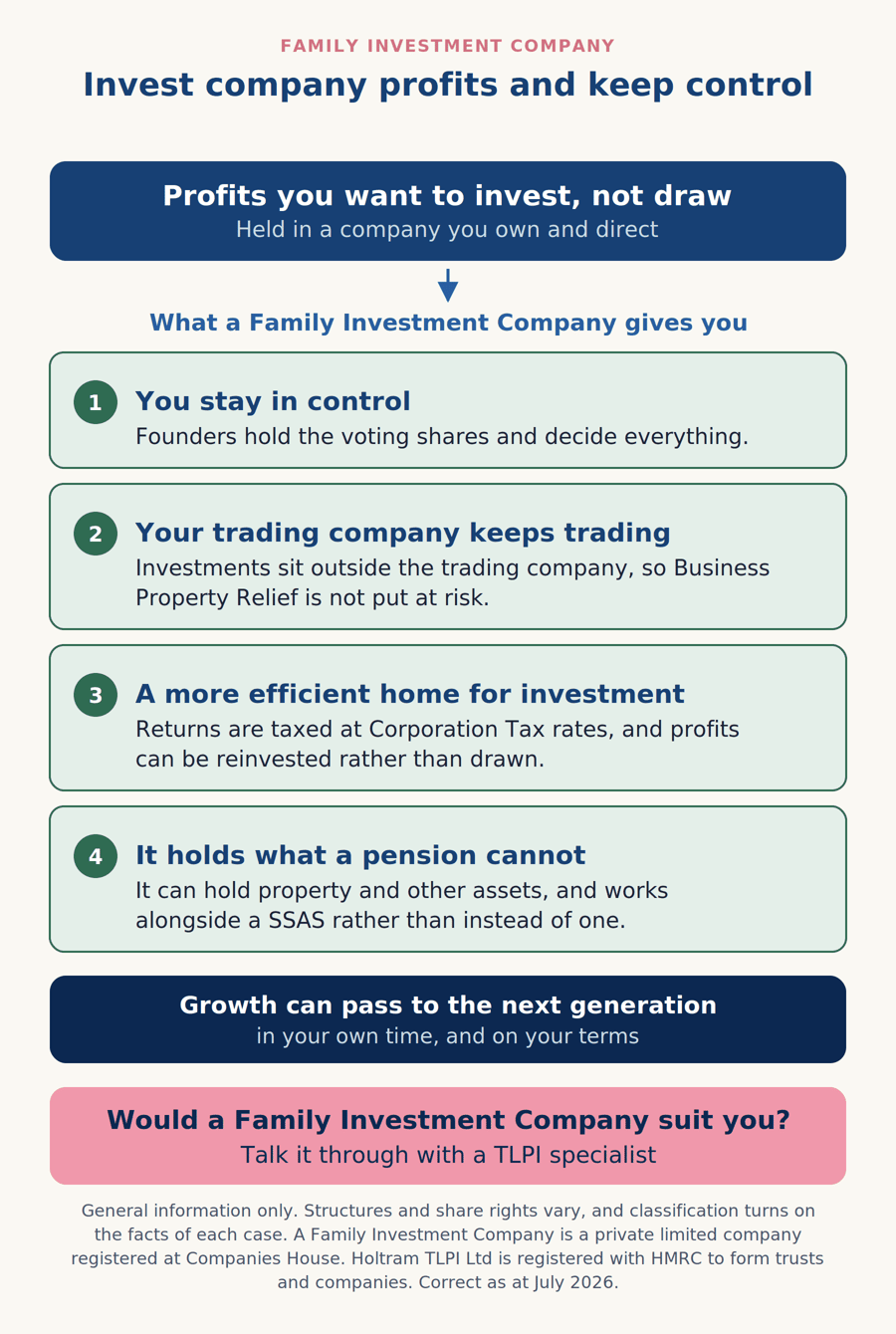
The diagram below sets out what the founders keep, which is the part most owners worry about losing.
A worked example: a family farming business
Let us look at the example of a large family farming business. The actual farm is of high value, with many acres of farmland and farm buildings. However, as far as liquidity is concerned, should short-term cash be required, it would mean selling off large assets or a portion of the farm. Without a tax plan in place, the farm finds itself subject to heavy tax liabilities, should the worst happen. In addition, the farmer is affected by the £2.5 million cap now applying to Agricultural Property Relief and Business Property Relief, so value above that threshold no longer attracts full relief.
The farmer can set up a FIC. This means that he can transfer income/profit into the FIC and mitigate tax liabilities. He can invest the funds as he sees fit, for example by loaning them to the business, or investing them in property. As he builds his property portfolio, owned by the FIC, he can have the peace of mind that it is protected. As the next generation takes ownership of the farm through a planned share strategy, the structure preserves the farm as a viable operation whilst ensuring that finances benefit the whole family. Aims and goals can all be achieved using various strategies within the tax plan.
What are the benefits of a Family Investment Company for a family business?
- Tax Efficiency: FICs provide opportunities to reduce IHT and CGT liabilities. Assets held within a FIC grow tax-efficiently. The FIC benefits the business, the family, and the beneficiaries as shareholders, thus protecting the business from certain tax burdens and dividends can be paid out with ultimate tax efficiency
- Control and Flexibility: The founder of the FIC retains control over decisions and how the FIC is managed whilst it facilitates the next generation benefiting from the legacy and sharing the company’s income if desired. The balance ensures business continuity, robust succession plans, and timely retirement strategies.
- Long-Term Security: Assets are held by the company rather than by individuals, which separates them from the trading company’s risks and keeps them positioned for the next generation.
What should you consider before setting one up?
Whilst a Family Investment Company has extensive benefits, it is important not to dismiss the complexities involved in setting them up correctly. Professional advice is recommended to make sure that your FIC is structured to optimise tax mitigation, meet HMRC regulations, and to ensure all aspects of your family business requirements for both now and the future are covered in your strategy.
Family businesses across many industries and sectors, from farms and personal services to warehousing, retail and leisure, must increasingly adapt to meet changes to tax legislation head on. A Family Investment Company is extremely powerful and enables businesses to achieve resilience and longevity for sustainable family legacies. A proactive approach to succession, legacy, and retirement planning is essential for business owners who want to safeguard their legacies, protect their assets, and build a platform for continued success.
The diagram below shows what changes on 6 April 2027, and what planning ahead of it involves.

When should a family business start succession planning?
As early as the structure allows. Share values grow over time, so transferring value sooner generally costs less tax than transferring it later, and a plan put in place years ahead gives far more room to manoeuvre than one written under pressure.
It is essential to leverage professional guidance when tax planning at this level. The earlier a tax plan is implemented, the better to ensure the business and the family benefit in full from the opportunities a Family Investment Company (FIC), a Small Self-Administered Scheme (SSAS) and a Lifetime Business Tax Plan (LBTP) can provide. Mitigating risks, reducing tax, and complying with legislative changes can be complex but are essential for family businesses.
The tax rules described on this page are correct at the time of writing, July 2026. Rates, allowances and reliefs change, and the April 2027 pension changes remain subject to further HMRC guidance. This page is information rather than advice. TLPI is a tax planning and pension specialist. Holtram TLPI Ltd is registered with HMRC to form trusts, companies and to administer pensions.
A free, no-obligation call to discuss your options.