
Most company directors know their company pays Corporation Tax. What fewer realise is that for companies earning between £50,000 and £250,000 per year, the marginal rate on each additional pound of profit is 26.5% — not the headline 25%. And when that retained profit is eventually extracted as a dividend, a higher-rate taxpayer pays 35.75% again on what remains. Working through the arithmetic, more than half of each pound of profit in this band can be consumed by tax.
Understanding the marginal rate
Corporation Tax in the UK (as at June 2026) operates in three bands:
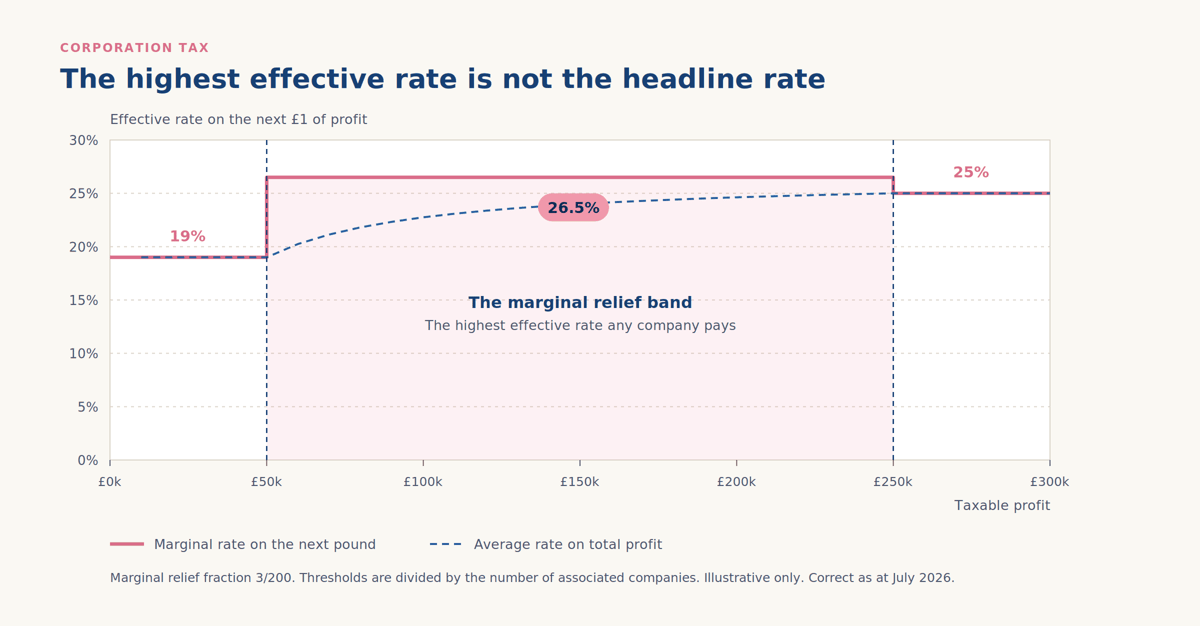
The chart below shows how the marginal relief band works, and why the effective rate on the next pound peaks at 26.5 per cent.
- £0 to £50,000: 19% (small profits rate)
- £50,001 to £250,000: marginal relief applies — the effective marginal rate on each additional pound is 26.5%
- Above £250,000: 25% (main rate)
A company in the marginal band earning £1 more of profit retains £0.735 after Corporation Tax. If the director then extracts that £0.735 as a dividend and is a higher-rate taxpayer, they pay 35.75% dividend tax — a further £0.248. From the original £1.00 of company profit, the director receives £0.487. The government receives the other £0.513.
Why SSAS contributions are different
An employer pension contribution to a SSAS is a deductible expense. It reduces the company's taxable profits before Corporation Tax is calculated.
The chart below traces where a single pound of profit ends up once Corporation Tax and dividend tax have been applied.
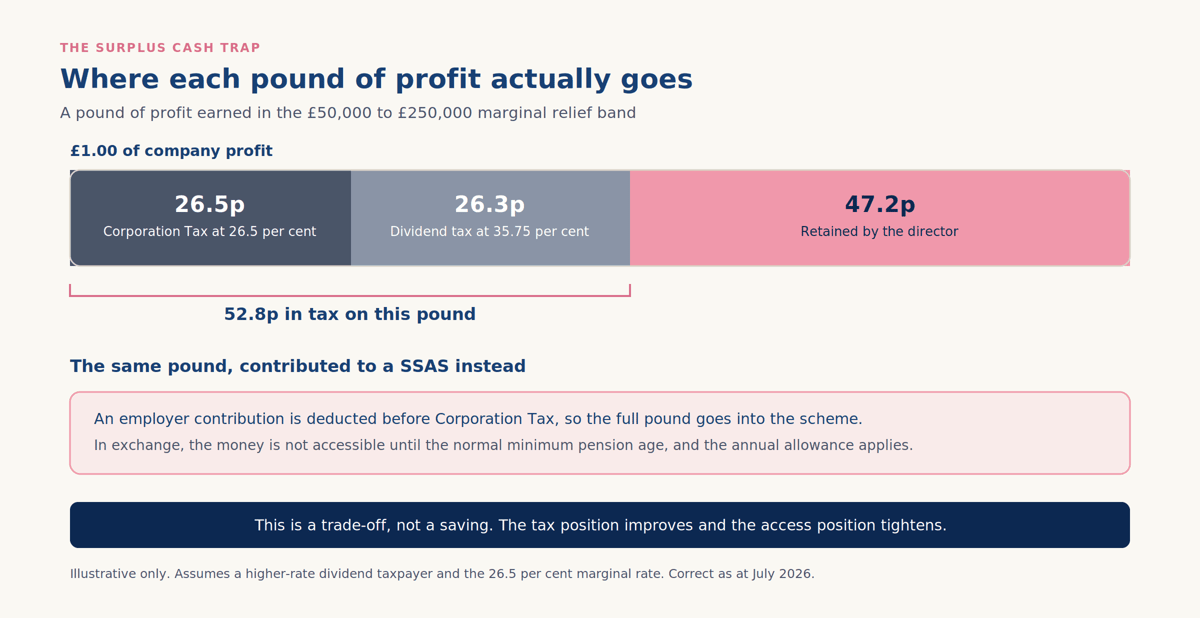
For a company in the marginal band, each £1 of employer pension contribution saves 26.5p in Corporation Tax. That £1 goes into the pension in full — no Corporation Tax deduction, no income tax, no National Insurance. Once in the pension, it grows free of Capital Gains Tax on investments and free of income tax on rental income. It can be drawn from age 57 (currently 55 until April 2028), with up to 25% tax-free.
The contrast with leaving cash in the company and extracting it as a dividend is stark. Both routes eventually result in money reaching the director. But the pension route reduces Corporation Tax, defers income tax, and grows the fund in a tax-efficient environment in the interim.
The practical limits
HMRC requires employer pension contributions to be "wholly and exclusively" for the purposes of the business. Large, one-off contributions are scrutinised more carefully than regular, commercially justifiable amounts. The annual pension input period limit — currently £60,000 for all pension contributions for an individual — also limits how much of the annual allowance can be used in any one tax year.
TLPI can help structure contributions that reflect the business's needs and comply with HMRC rules, including strategies for making use of carry-forward allowances from prior years where the annual allowance was not fully used.
- Surplus cash in the £50k-£250k profit band is taxed at the 26.5% marginal Corporation Tax rate
- Extracting that cash as a dividend adds a further 35.75% for higher-rate taxpayers — a combined rate above 50%
- SSAS employer contributions reduce taxable profit before Corporation Tax applies
- Each £1 of employer pension contribution saves up to 26.5p in Corporation Tax for companies in the marginal band
TLPI works with company directors to structure SSAS employer contributions that reduce Corporation Tax and build pension wealth efficiently.