
When you sell your company, claim a pension deduction, or plan an estate around your business, HMRC applies a test to determine whether your company is genuinely a trading company or primarily an investment vehicle. The distinction matters because the most valuable tax reliefs in the UK — Business Asset Disposal Relief (BADR), Business Property Relief (BPR) for Inheritance Tax, and the ability to make substantial employer pension contributions — are all reserved for trading companies, not investment vehicles.
What is the test?
For Business Property Relief, HMRC asks whether the business consists wholly or mainly of making or holding investments, judged on the overall balance of the business rather than against a percentage. A 20% benchmark does exist in HMRC guidance, but it belongs to certain Capital Gains Tax reliefs such as Business Asset Disposal Relief, not to Business Property Relief. Trading means actively buying, selling, manufacturing, or providing services. Investment means holding assets — property, shares, loans and funds, or large cash reserves — and earning income passively.
The diagram below shows how the drift happens, and what a plan does to stop it.
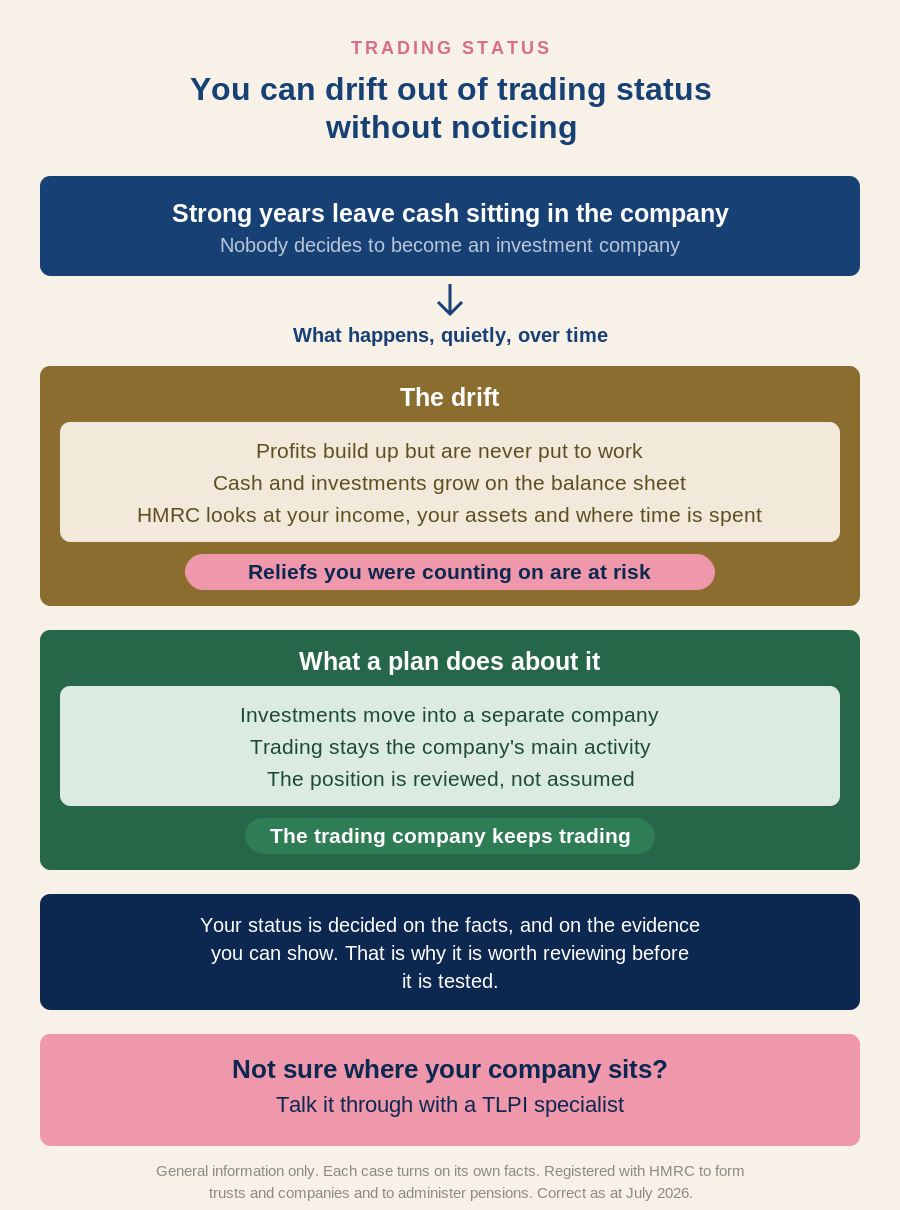
The test looks at a combination of factors: income sources, asset composition, employee time, and the nature of the business's activities. No single factor is conclusive, but HMRC considers the overall balance.
What pushes you towards investment status?
Several common business patterns can tip a company towards investment classification.
Surplus cash and liquid assets. A company that has accumulated large cash reserves — perhaps from years of profitable trading — may find that its asset base is now predominantly investment in character. HMRC has challenged companies where retained profits built up to the point where investment assets exceeded trading assets.
Property holdings. Holding commercial or residential property as a passive investment (rather than as part of a trading property business) counts as investment activity. The proportion of rental income versus trading income is closely scrutinised.
Minority shareholdings. Passive stakes in other companies, where your company is not actively involved in management or trading, are treated as investment assets.
Why does it matter for SSAS?
A SSAS is an occupational pension scheme. If HMRC challenges whether your company is a trading company, the employer's ability to claim Corporation Tax relief on pension contributions may also be scrutinised. Contributions must be wholly and exclusively for the purposes of the trade.
More broadly, your personal tax position on a company sale depends on Business Asset Disposal Relief, which applies a reduced Capital Gains Tax rate rather than the main rate. BADR requires the company to be a trading company. For Inheritance Tax, Business Property Relief reduces the value of business assets — and the same trading vs investment test applies.
What can you do?
With advance planning, a company can restructure its activities, reduce its passive assets, or transfer investment assets out of the trading vehicle. SSAS employer contributions can help reduce the pool of surplus cash sitting in the company — each contribution is both a deductible trading expense and a step towards a more active asset profile.
HMRC takes a sceptical view of last-minute restructuring before a company sale. The earlier you address the trading vs investment balance, the more options remain open.
- A company is "mainly trading" when the overall balance of the business is commercial trading rather than passive investment - HMRC judges this in the round, not against a percentage
- Failing the test can disqualify your company from Business Asset Disposal Relief, Business Property Relief, and pension contribution relief
- Surplus cash, passive property, and minority shareholdings all count as investment activity
- SSAS employer contributions reduce your company's investment-heavy cash position and are a deductible trading expense
TLPI works with company directors to structure SSAS pensions and Corporation Tax planning that keeps your business on the right side of HMRC's test.